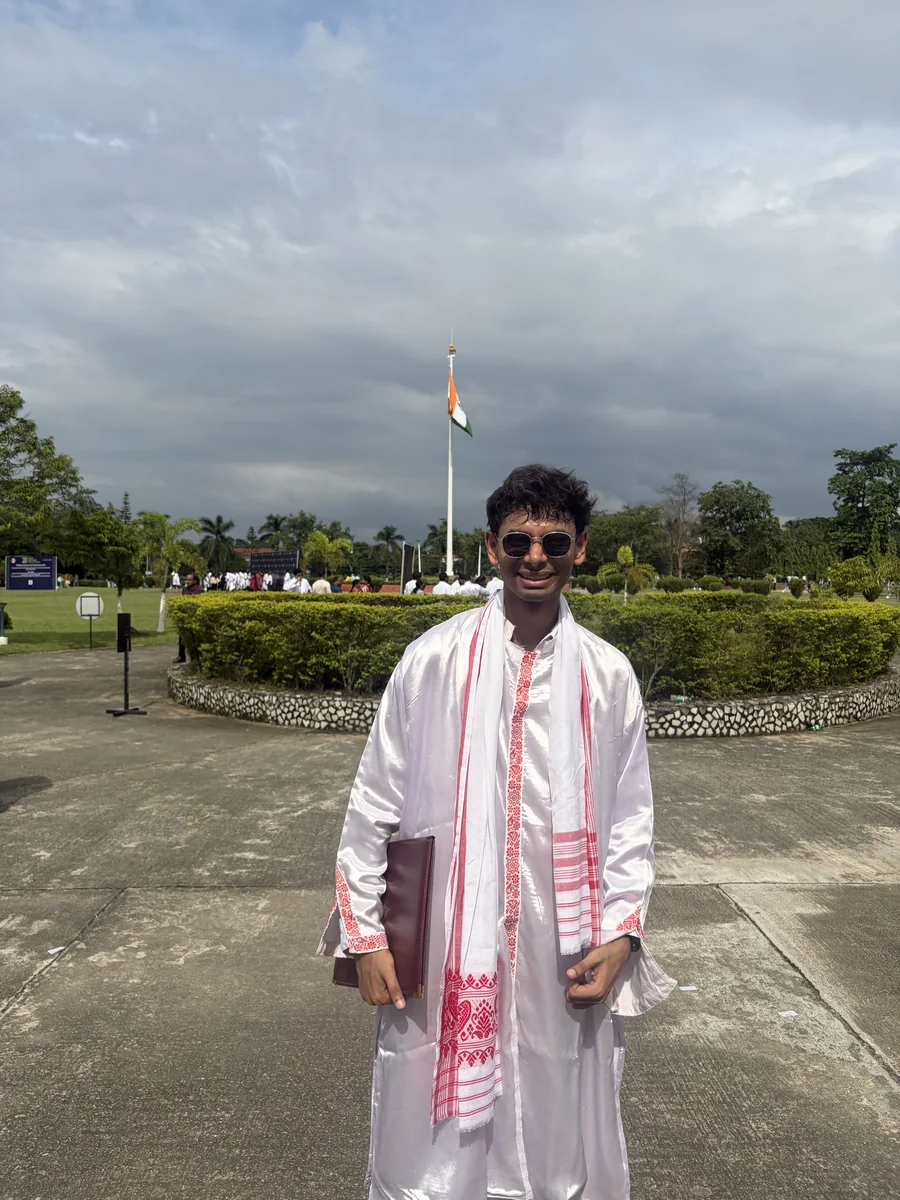
Inter-IIT Tech Meet 12
Rank 1 of 20 IITs on the Mphasis problem statement, with the quantum passenger-recovery engine.
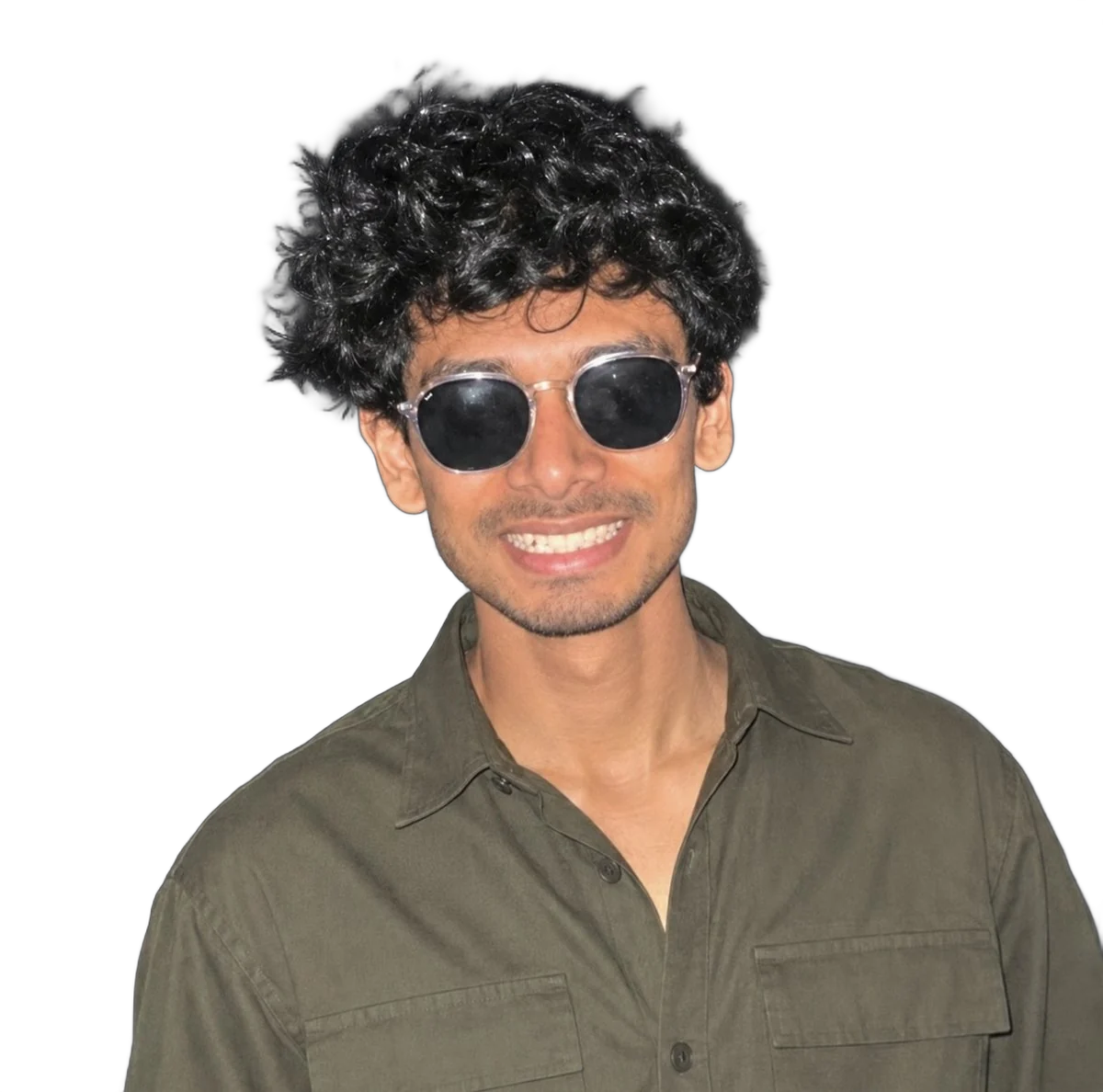 hover to see what the model sees
I build LLM systems that hold up in production, and get a little better every day they run.
Every system starts as noise.
Then you give it structure: retrieval, agents, evals.
Until it's something you'd trust with real money.
I'm an AI engineer out of IIT Guwahati. I like the part of LLM work that happens after the demo: evals, failure modes, feedback loops, and the slightly unglamorous plumbing that makes a model trustworthy enough to touch money. I'd rather own a hard problem end to end than a safe slice of an easy one.
saved every month by an LLM pipeline that adjudicates warranty claims
fewer daily claims, 1,500 down to 500, once evidence-based auto-rejection closed a fraud loop
daily autocomplete calls served by the NER model I trained for Ola Maps
technicians onboarded onto a CRM we built in 10 days to replace Salesforce
Technicians were claiming replacements for healthy parts and reselling the originals. Reviewing 1,500 claims a day by hand didn't scale and didn't catch it. So we built agents that read the evidence the way a senior reviewer would, and a loop that turns every disagreement with a human into a better rulebook.
A technician files a replacement with evidence: voltage readings, part diagnostics, SOP videos. The scooter's telematics come along too, often thousands of raw sensor readings.
Motor, battery, VCU and BMS each get a dedicated LangGraph agent with that part's SOP and failure signatures. I compressed telematics with PAA into a few hundred segments, which cut token cost roughly in half without losing the signal.
Every day, reviewers check a slice of decisions and flag disagreements: wrong approvals, wrong rejections, and right answers reached for the wrong reason.
Each disagreement is structured and labelled as a missing rule, an ambiguous rule, two rules in conflict, or a one-off slip. A fix is only proposed once several similar misses cluster together, so the prompt doesn't rot into contradictions.
The policy lives in one large prompt with anchors marking where each piece of logic sits. Fixes land surgically at an anchor instead of rewriting the whole thing, which is also where a big chunk of the token savings came from.
Every patch runs against a golden set: the cases that triggered it plus nearby cases it used to get right. Then a day in shadow on live traffic. A false approval costs real money, so anything that could raise them waits for a human sign-off.
Passing patches go live, every version is kept for instant rollback, and the loop starts again tomorrow. Agreement with human reviewers went from 86% to 90%, and daily claims dropped from 1,500 to 500.
The Salesforce contract was running out and the service network couldn't stop for a migration. Five of us rebuilt the CRM in Spring Boot in ten days: tickets, inventory, billing, insurance and pan-India role-based access, with every historical job card carried over. I owned the warranty and insurance integrations with Reliance, Acko and Ola, each with its own eligibility rules and invoice format.
A CRM built in ten days has a rough first week. Rather than triage every broken record by hand, I built a war-room agent on MCP that reads the codebase and the database, works out why a job card is stuck, fixes the data and raises the code fix as a PR. Anything destructive waits for a human yes in Slack.
job cards repaired by the agent
Argument mining turns prose into a graph of claims, premises and the links between them. The usual answer is a fine-tuned model, which needs piles of labelled data and stumbles on unfamiliar text. With Prof. Ashish Anand, I made the opposite bet: no fine-tuning at all, just three agents and very carefully chosen examples.
Every training paragraph is stored twice: as an embedding in ChromaDB, and as a discourse tensor from a DMRST parser that captures how the argument is built. Spectral similarity links paragraphs with the same shape into a NetworkX graph, whatever they're about.
A new paragraph pulls its five nearest neighbours by meaning, expands two hops through the structure graph to about fifteen candidates, and keeps the five that score best on a blend of semantic and discourse similarity.
One agent extracts claims and premises, one maps supports and attacks, and a reviewer checks the graph for logical holes. If it fails, the feedback goes into a shared state and the agents try again, up to three rounds.
Grey: GPT-OSS-20B. Orange: GPT-5 Mini. Dashed: fine-tuned state of the art.
Indian addresses don't follow a format. People type a flat number, a landmark, half a locality and a pincode, in any order. As an intern on Ola Maps I worked on both ends of a ride: finding the place, then predicting when you'll get there.
Productionised a spaCy NER address parser for autocomplete and forward geocoding, after benchmarking it against BERT-style transformers. Live, it lifted top-3 search accuracy by 2%.
Retuned the live historical ETA lookup with Bayesian optimisation in Optuna, on cyclic time features and geospatial ones. 60% of rides now land within 10% of the predicted ETA.
Tier-3 cities don't have enough rides to learn from, so I clustered location services and road segments into sub-city zones with DBSCAN. Error there dropped by about 3 minutes.
Traced a systematic ETA overestimate on long highway segments back to the dataset logic and fixed it, and patched routing anomalies on newly built links.
Showed that electric-vehicle ping data was dense enough to feed routing models, and tested bucketing schemes for predicting segment popularity.
Generic RAG falls apart on legal text, where one answer needs clauses stitched together from different documents. We built on LLMCompiler, so a planner lays out a DAG of retrieval tasks up front and independent sub-queries run in parallel.
Retrieval goes through Voyage-Law2 and Cohere reranking, then an auto-merger that rejoins clauses split mid-chunk. A joiner grades whether the evidence actually answers the question and replans if not, falling back to a beam-search retriever for multi-hop chains, then to a human. Claude and OpenAI back each other up so one outage can't take it down.
When an airline changes its schedule, thousands of passengers have to be moved onto other flights without breaking PNR priority, cabin class, connection times or special passenger needs. For Mphasis's problem at the 12th Inter-IIT Tech Meet, we built a rule engine that scores every PNR and every candidate flight, then solves the reassignment as a mixed-integer program.
We solved it classically with Gurobi and as CQM and BQM formulations on D-Wave's quantum annealer, and sped up preprocessing with prune-and-search, multithreading and dynamic programming. The rules live in a Streamlit UI, so an operations team can retune them without touching code. It took gold, first of 20 IITs.
Scanned medical PDFs mix lab tables, prescriptions, discharge notes and X-rays on the same pages, and one generic prompt kept hallucinating structure. I split the job across 14 narrow MedGemma agents on Vertex AI, plus a YOLOv8 model I fine-tuned on a 301-image dataset I annotated myself to find scans inside PDFs. Every detected crop gets a second opinion from an LLM before it's accepted.
A shared report summary feeds the downstream agents so nothing re-reads raw pages, and a layered JSON repair chain keeps structured output from breaking. In the UI you can draw a box on a scan and ask about just that region.
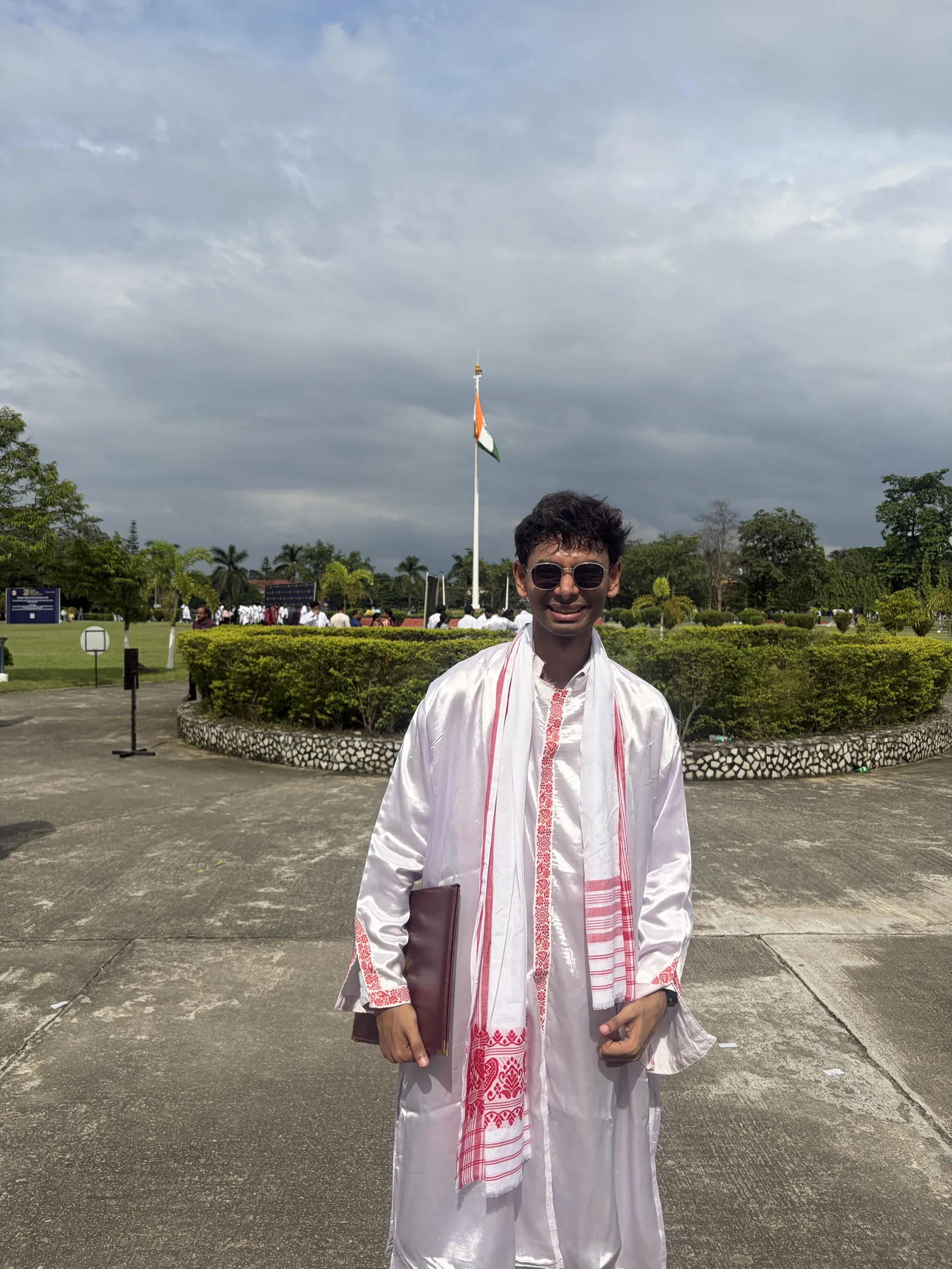
Indian Institute of Technology Guwahati
B.Tech CSE · Minor in Data Science & AI · CGPA 8.92
Graduate Engineer Trainee, Applied AI
The self-improving warranty pipeline and the SAFAI war-room agent. Case studies 01 and 02
Undergraduate researcher, agentic argument mining
Advised by Prof. Ashish Anand. Resource paper submitted to LREC 2026. Case study 03
AI Engineer Intern, Ola Maps
Address NER for autocomplete at 50M+ calls a day, and ETA prediction. Case study 04
Rank 1 of 20 IITs on the Mphasis problem statement, with the quantum passenger-recovery engine.
Out of 20,000+ students from IITs, NITs and IIITs. Won a scholarship.
Of 22 IITs on the Pathway GenAI problem.
Out of 5,000 participants. Prize winner.
Max rating as mahnameisayush.
Cleared IOQM, selected for the national training camp (INMOTC).
State topper in IOQP, qualified for INPhO.
Cleared IOQC and IOQA, qualified for INChO and INAO.
All India Rank 863.
98.8%, third in the state.
LangGraph, LangChain, MCP, RAG, tool calling, LLM evaluation, prompt optimisation, ChromaDB
PyTorch, spaCy, scikit-learn, pandas, NumPy, YOLOv8, FastAPI, REST, Redis, Docker
Python, C/C++, SQL
I'd rather be on the hook for a harder problem with real autonomy than a safer one with none.